
In the 2026/27 season the Süddeutsches Sinfonieorchester starts out with fresh artistic impulses! We are especially delighted to announce that the pianist Lisi Namchevadze will accompany the coming season as Artist in Residence.
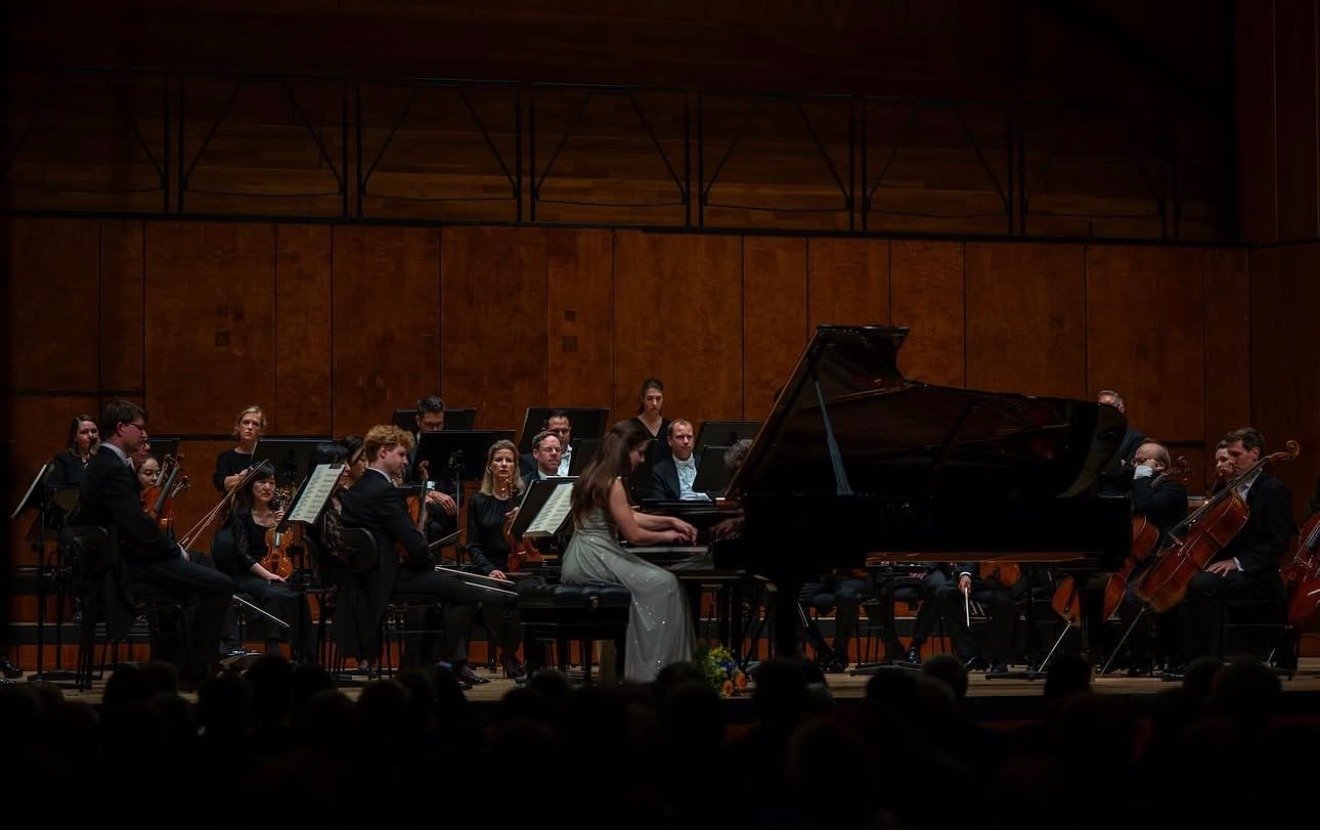
The young Stuttgart pianist, already hailed by the press as a “musician of the future” and an official "Steinway Artist", has attracted attention in recent years with numerous appearances. She opened the 2025/26 season as soloist with the Stuttgart Philharmonic in the Beethovensaal of the Liederhalle, and has also been heard in renowned concert halls such as the Concertgebouw in Amsterdam, Carnegie Hall in New York and the Laeiszhalle in Hamburg.
Besides the symphony concerts, she will also be heard in chamber music concerts of the Süddeutsches Sinfonieorchester. In this interview we offer a first glimpse:
You grew up in a family of musicians: both of your parents are professional musicians, and both made piano playing their career. Was it clear to your parents from the outset that their daughter would also follow a path in music, or how did your love of the piano develop?
That’s right: my parents were actually still studying when I was born. So even from the earliest age I heard a great deal of piano music at home. That seems to have left a lasting impression on me: at the age of three, as my mother told me, I sat down at our piano by myself and pressed the first keys. That made it clear to my parents that I enjoyed playing the piano, and a short time later I had my first piano lessons with Mr Romuald Noll at the Stuttgart music school. So I would say that my love of the piano began in childhood – and has only kept growing over the years.
That sounds as though you made a firm decision about your instrument at a young age. Many children in Germany try out different instruments in early musical education to see which suits them. Did you ever consider discovering the world of music on another instrument as well?
When I was younger I often wished I could play a string instrument too; the violin in particular appealed to me. The special thing about the piano is that you mostly make music alone, which is different with the other instruments. Playing in an orchestra is of course a very special attraction: the connection between the individual musicians in the orchestra and the pleasure of making music together are truly unique. Nevertheless, my interest in the piano was the strongest, and I focused on it – which of course doesn’t mean that there aren’t other wonderful instruments too!
You have already spoken about your steadily growing love of music. When did you first have the wish to turn the “hobby” into your profession and devote yourself entirely to the piano? Are you working towards a great goal that you absolutely want to achieve in your career?
The wish to become a pianist came at about the age of 13 or 14. I have always admired the pianist Martha Argerich in particular, performing at her concerts in a wonderful gown, and that gave me the idea: I want to have such a wonderful profession too! Of course you can never know for certain how far you will get, and the musician’s profession demands a great deal of time and effort, but that never made me give up my dream of becoming a pianist. I don’t have a concrete goal for my career; I simply try to give my all, both on stage and when practising at home, and to keep improving. Everything else will show itself in time.
To show your best on the concert platform, a great deal of diligence and precision in practice is required. What does your musical work on the pieces look like – have you developed methods for learning and understanding music? That is often not an easy task.
That’s true: practising properly isn’t that easy at all. Over the years, training the hands separately has proved its worth for me, so that I can be sure both hands work well in terms of technique and fluency, but also dynamically and in their articulation. Combined with slowly putting them together afterwards, that is the most sensible way of learning for me personally. You discover the music and the composer’s ideas more and more over the years, and working precisely with the score is very important. In addition, my professor is of course at my side above all, but you can also get to grips with the music through recordings and books. Ultimately it is the interplay of everything that shapes my performance on stage, and in my opinion it is important to strike a good balance between realising one’s own artistic identity and the ideas the composer had for the work.
For many people, standing on stage is associated with nervousness and stress, especially when there are such enormous challenges to master as you experience as a pianist. How do you cope with the growing attention paid to you and the pressure that goes with it?
The pressure to deliver is of course there, and it can probably never be avoided entirely. With time, though, you get used to the feeling and learn to deal with it. I do of course still feel nervous before concerts; a little of that is certainly good for concentration during the concert, but in my case the joy of music always outweighs it. That is ultimately the reason why I do all this: music gives me the possibility of expressing my thoughts and feelings. If I can also reach the audience with it and bring them joy through my playing, I can be very satisfied with myself, even if not everything went perfectly.
Bringing joy to people – that is a good cue. These days culture is unfortunately receding increasingly into the background, in view of the global and political challenges that have become part of everyday life. In what way do you see music as a chance to bring people together again and, as a bearer of hope, to show a way forward in seemingly hopeless situations?
Music has an enormous power that we as human beings can feel. It builds bridges between people and gives expression to everything for which words no longer help. In principle, music is a kind of universal language that every person can speak and understand. Making music together can therefore well be used as a metaphor for living together in society – by focusing on what connects people rather than on what divides them. I consider that enormously important in today’s world!
To conclude, let us talk about your residency in the 2026/27 season with the Süddeutsches Sinfonieorchester. In the orchestra’s still young history, you are the first artist ever to take on this role. How does that make you feel, and how did the collaboration come about?
It is a very special honour for me to be the first Artist in Residence at the SDO. I love working with an orchestra, and I also see a great opportunity for my career in this collaboration. I have been bound to the Süddeutsches Sinfonieorchester by a deep friendship from the very beginning; I have known many of the musicians since childhood, and so it gives me fresh pleasure every time to see these people again. Of course, I accepted with delight when the orchestra made me the special offer of working with the SDO. I am sure that a successful and fruitful cooperation lies ahead of us!
The pleasure is entirely ours! To finish, let us talk about the concerts we will give together: the programme includes piano concertos by Bach and Beethoven. How did this choice of works come about, and what makes these pieces so special?
I am very happy about the piano concertos I will be playing with the SDO! Beethoven’s Piano Concerto No. 5, Op. 73 in particular is one of my favourite works for piano and orchestra; the passion and power in this concerto are truly unique. Beyond that, the piece is very chamber-music-like: right at the start the orchestra opens with a triumphant E-flat major chord, which the piano joins and then answers with jubilant arpeggios. This interplay between the two parts runs through the entire piece and makes the performance a special experience. The Piano Concerto in D minor by Johann Sebastian Bach was an idea of the conductor’s that thrilled me at once. This piece has a very special verve and is a compositional masterpiece by the famous composer – and belongs to the standard repertoire of every concert pianist. These will certainly be two breathtaking concerts!
Thank you so much for the conversation! All the best, and see you soon!
My pleasure, I really enjoyed it!