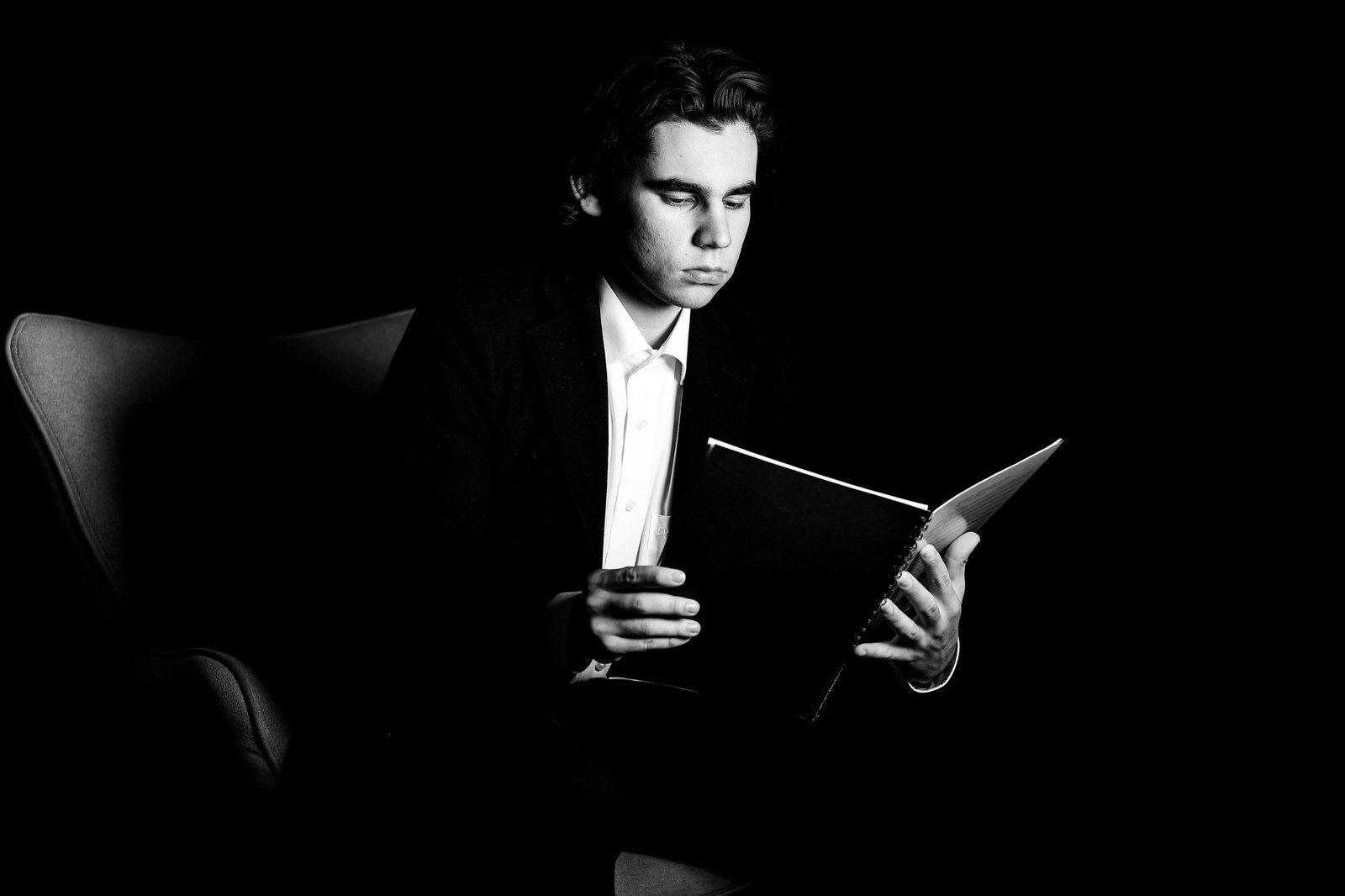
In terms of its length, the composition to be premiered in February could be called a concert overture, but in the nature of its music it is ultimately a tone poem. Its source is the book “The Little Prince” by Antoine de Saint-Exupéry. I am also very interested in other art forms, be it poetry, painting, photography, philosophy or the natural sciences. I came across the book through a friend, the dancer and choreographer Carlos Strasser, who used this material for a choreography. After reading it, it was clear to me that I had something to say about this subject; that I wanted to take up the thoughts expressed in it and develop them further.
“The Little Prince” is conceived as a children’s book, but when reading it one realises that it is not a blunt, fairy-tale narrative but a deeply philosophical work that addresses many aspects of being human and of the development towards it. At the same time, I have to admit that the more I engage with it, the less I understand what is in the book. My suspicion is that this is because I can no longer read the text through the eyes of a child, but only through my moderately settled nature as a young adult. Yet this supports precisely one of the work’s central messages.
In terms of content, it is an exciting but ultimately deeply tragic story: which planets the little, innocent and curious prince travels to, and what conflicts open up within him as his experience grows and he meets people. Considering that it is a book for children, I find it all the more shattering what way out the little prince takes in the end in order to return to his home planet and his beloved rose. The ending is open; one does not know exactly what happened. The prince’s intention is to realise the will of his spirit and to follow his longing, and in order for, or while, the spirit lives on, the body has to be left behind on Earth as a shell.
My task in composing is to capture the spirit of the work and translate it into a musical language. For this relatively short piece, it is therefore not a matter of retelling the plot directly, but rather of developing the ideas further and characterising them musically. In general, one of the things that defines art for me is that it explores profound questions and passes them on to people.
One core idea is the bewilderment at being grown-up. Adults are so firmly set on their profession, their duties, the role into which the world’s expectations have moulded them, that they see only what is rational and productive. In doing so they lose their imagination; they no longer see the deeper meaning and beauty in what they do and in what the world has to offer.
Quotations from the book:
“All grown-ups were once children, but only few of them remember it.”Antoine de Saint-Exupéry, The Little Prince
“He was too busy counting numbers and owning stars to really see anything beautiful.”Antoine de Saint-Exupéry, The Little Prince
Another important aspect is the personal relationships we cultivate: how they can cause inner conflict, but also bring happiness. On his home planet the little prince has a rose that he looks after, but whose behaviour unsettles and hurts him, until he decides to leave his planet. Only on Earth, when he sees a garden of 5,000 roses, does he realise that the rose on his planet is unique and special to him, because it was the one he had cared for. The question is what it means to love, what responsibility comes with it, and what good it may have done. At the same time, though, it also means taking the risk that, when you tame each other and become familiar, you will inevitably be sad when you have to part, precisely because you have formed a bond. I find the symbol of the rose fascinating, for it carries charm with it, but also thorns on which one can hurt oneself. It is too late when the little prince realises what he had in his rose, yet it is nevertheless beautiful that every time he now looks up at the stars he can be glad, because he knows that on one of those stars his rose is looking down at him.
Tragically, in concrete terms, the little prince longs in the end for his planet and his rose, but there is some barrier that no longer makes it possible for him to return to what has been. It is in these words that one realises that whatever the worldly does, your own spirit and memory can be eternal. The little prince wants to leave his body behind on Earth through the venom of a snake bite, in order to be with his beloved rose again. Ironically, as an adult I can imagine what this might mean more precisely, and how dramatic his way out was.
Probably the most important message in the book is that of the truthfulness of the heart. That one can see what is essential only with the heart, that it cannot be measured or described superficially. That language and words only cause misunderstandings. That what is truly important cannot be rational. What exactly the essential is supposed to be, I think each person will have to work out for themselves. But the thought I would like to pass on with this work is:
“One sees clearly only with the heart. What is essential is invisible to the eye.”Antoine de Saint-Exupéry, The Little Prince
Even as adults, we can certainly learn a great deal from a child. The thoughts that are shared with us strike us directly in the soul. If we open ourselves to them and try to recognise that, despite any inner conflicts or outside expectations, we can see deep in our hearts what has really been good and will be. That the world and its development seem sensible, but can also distract us from what is essential. In a world that is moving ever further from nature, that enriches much through technology but also turns much upside down, it would be advisable to let our inner child come to life. Not only to see what others want from you and what you have to do, or to do what makes sense, but to experience the world with curiosity and to preserve our imagination.
An essential question that has occupied us humans for some time, but now more and more, is: what is actually still real? What is still truthful, and what do we really need? In our striving for progress, have we forgotten ourselves as human beings? Do we need to return to nature, or how much further will we be able to push “progress”?
December 2025, Patrick Giesel