← All concerts

Symphony Concert in Neckarsulm

Zeitenbruch!

DateSat 19 Dec 2026 · 7:30 pm
VenueBallei Neckarsulm, Theatre HallDeutschordensplatz 1, 74172 Neckarsulm
©Stefan Guth

Programme

Wolfgang Amadeus Mozart (1756–1791)

Violin Concerto No. 3 in G major, K. 216

Composed 1775 · approx. 25 min.
  1. Allegro
  2. Adagio
  3. Rondeau. Allegro
Interval
Arnold Schönberg (1874–1951)

Verklärte Nacht, Op. 4, version for string orchestra

Composed 1899, string orchestra version 1917/1943 · approx. 30 min.
Richard Strauss (1864–1949)

Metamorphosen. Study for 23 solo strings

Composed 1945 · approx. 27 min.

Performers

Violin
OrchestraSüddeutsches Sinfonieorchester

About the concert

The guest performance in Neckarsulm takes “Menschwerden” (“Becoming Human”) as its guiding theme: the works speak of upheaval and loss, but also of the search for hope and renewal.

Wolfgang Amadeus Mozart wrote his Violin Concerto No. 3 in G major, K. 216 in 1775 in Salzburg, aged nineteen, in the year in which almost all of his violin concertos were composed. The work combines youthful freshness with great elegance: a radiant first movement, a heartfelt, singing Adagio and a playful rondo that, in the middle of the dance, unexpectedly turns to folk-like music.

Arnold Schönberg’s Verklärte Nacht was written in 1899 as a string sextet, arranged for string orchestra in 1917 and revised once more in 1943. The work follows a poem by Richard Dehmel: on a nocturnal walk, a woman confesses to her lover that she is expecting a child by another man, and he accepts her and the child with love. Dark, turbulent sounds give way to a warm, bright D major, and the night is “transfigured”. The music is regarded as a key work on the threshold of modernism.

Richard Strauss wrote his Metamorphosen in 1944/45 under the impression of the destruction of German cultural landmarks, including the opera houses in Munich, Dresden and Vienna. The work is scored for 23 solo strings, with every part played by a single player. Towards the end Strauss quotes the funeral march from Beethoven’s Eroica and adds the words “In memoriam!”.

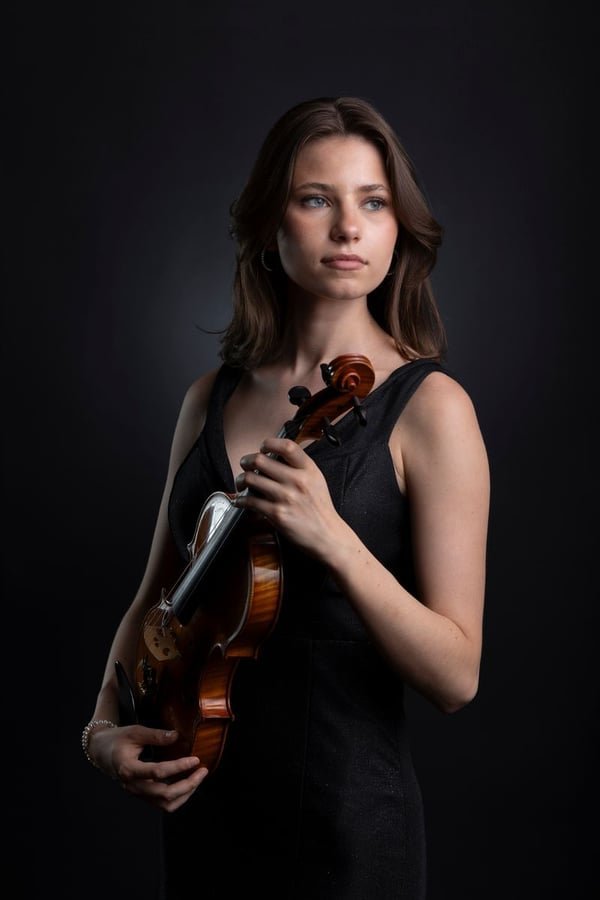
Louisa Oppawsky

Violin

Louisa Oppawsky

Louisa Oppawsky was born in June 2007 and began playing the violin at the age of six. She joined the “Begabtenförderung” (gifted-student programme) at the Heilbronn municipal music school and, at 13, entered the Würzburg “Precollege” as an early-entrance student. In 2023 Louisa became a junior student at the Stuttgart University of Music, studying with Prof. Christine Busch. She has played in the Landesjugendorchester since 2021 and in the Bundesjugendorchester since 2023, with which she toured Great Britain and other European countries in January 2025.

In her home town she was soloist and concertmaster of the Jugendsinfonieorchester Heilbronn. She was a long-standing member of the “Amadé” network, with performances at Mannheim Palace, and has taken part in national and international competitions. She won prizes at the international violin competition in Wrocław and, in 2023, a First Prize and the UNESCO Special Prize for the best chamber music performance as a violin/viola duo at the Concorso Internazionale Città di Palmanova.

Louisa is also a multiple national prizewinner at the “Jugend musiziert” competition. Most recently, in 2024, she received a First National Prize with maximum points in the piano/violin duo category, as well as the Carl Schroeder Förderpreis.

In April 2025 she took part in “Musik Miteinander” at the Kronberg Academy. In July 2025 Louisa completed her Abitur and in October 2025 began her Bachelor’s degree with Prof. Christine Busch at the HMDK Stuttgart.

Since October 2025 she has also been a scholarship holder of the Benno Kittel Foundation.

Louisa has attended masterclasses with Martin Tittor, Prof. Herwig Zack, Prof. Ingolf Turban, Eduard Sonderegger, Prof. Christine Busch and Prof. Kirill Troussov.

Louisa plays a violin by Gian Carlo Guicciardi, on loan from the Deutsche Stiftung Musikleben.