← All concerts

2nd Symphony Concert

Zeitenbruch!

DateWed 16 Dec 2026 · 7:30 pm
VenueLiederhalle Stuttgart, MozartsaalBerliner Platz 1–3, 70174 Stuttgart
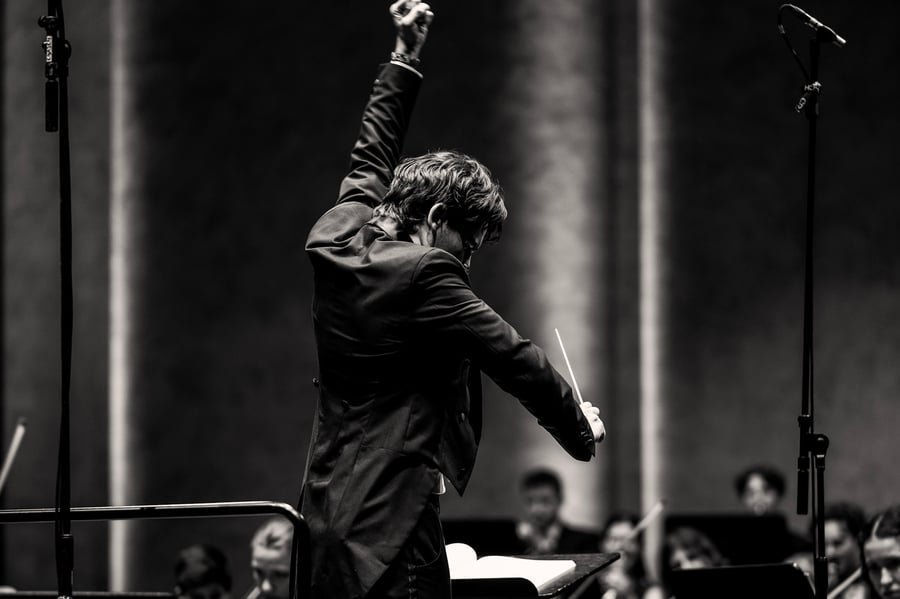
©Konstantin Arutyunyan

Programme

Johann Sebastian Bach (1685–1750)

Concerto for Keyboard and Strings in D minor, BWV 1052

Composed c. 1738 · approx. 23 min.
  1. Allegro
  2. Adagio
  3. Allegro
Interval
Arnold Schönberg (1874–1951)

Verklärte Nacht, Op. 4, version for string orchestra

Composed 1899, string orchestra version 1917/1943 · approx. 30 min.
Richard Strauss (1864–1949)

Metamorphosen. Study for 23 Solo Strings

Composed 1945 · approx. 27 min.

Performers

Piano
OrchestraSüddeutsches Sinfonieorchester

About the concert

The season’s second Symphony Concert, under the guiding theme of “Becoming Human”, speaks of upheaval and loss, but also of the search for hope and renewal.

Johann Sebastian Bach’s Keyboard Concerto in D minor, BWV 1052, was written in Leipzig around 1738, probably after an older violin concerto, and was intended for Bach’s Collegium Musicum. The opening alone, in which the entire orchestra states a sharply accented theme in unison, reveals the dramatic force of the work. In the Adagio the piano sings a long-breathed melody above a calmly pacing bass, before the finale races off with irrepressible energy.

Arnold Schönberg’s Verklärte Nacht was composed in 1899 as a string sextet, arranged for string orchestra in 1917 and revised once more in 1943. The work follows a poem by Richard Dehmel: on a nocturnal walk, a woman confesses to her lover that she is expecting a child by another man, and he accepts her and the child with love. Dark, turbulent sounds give way to a warm, radiant D major, and the night is “transfigured”. The music is regarded as a key work on the threshold of modernism.

Richard Strauss wrote his Metamorphosen in 1944/45 under the impression of the destruction of German cultural landmarks, among them the opera houses in Munich, Dresden and Vienna. The work is scored for 23 solo strings, each part played by a single player. Towards the end Strauss quotes the funeral march from Beethoven’s Eroica and adds the words “In memoriam!”. This closes a circle with the season opener, whose programme featured that symphony.

Lisi Namchevadze

Piano

Lisi Namchevadze

Lisi Namchevadze, born in 2008, is one of the outstanding young pianists of her generation. Her exceptional musical talent showed itself early, and she has developed it continuously at the Stuttgart Music School since 2012. Since 2023 she has been a pre-college student at the Stuttgart University of Music and Performing Arts, and from 2026 she will begin her Bachelor’s degree at the Royal College of Music in London. In 2025 she was awarded the international title “Young Steinway Artist”. Elisabeth Namchevadze is a multiple prizewinner at numerous national and international competitions. As early as 2018 she won First Prize at the Kleiner Schumann Competition in Zwickau, together with a special prize for the best interpretation of a work by W. A. Mozart. Prizes followed at, among others, the International Rotary Piano Competition in Essen, the American Protégé International Concerto Competition in New York, the Carl Bechstein Competition in Berlin (First Prize), the Steinway Piano Competition in Hamburg (First Prize) and the VIII Tbilisi International Young Pianists Competition, where she likewise took First Prize. She has repeatedly been awarded First Federal Prizes at Jugend musiziert. Her most recent successes include First Prize at the Charleston International Piano Competition (USA), the Absolute First Prize at the Orbetello International Piano Competition (Italy) and further first prizes at international competitions in Brescia and Montecatini. For her outstanding Beethoven interpretations she received the Hermann J. Abs Prize in 2023 and 2024. A sought-after soloist, Elisabeth Namchevadze has performed in major concert halls at home and abroad, including the Laeiszhalle Hamburg, the Mozart and Beethoven Halls of the Liederhalle Stuttgart, the Concertgebouw Amsterdam, Carnegie Hall in New York, the Beethoven-Haus Bonn, and in Tbilisi, Berlin and the Netherlands. She has appeared with renowned orchestras such as the Georgian Symphony Orchestra, the Tbilisi Youth Orchestra, the Mendelssohn Chamber Orchestra and the Stuttgart Philharmonic. For the 2025/26 season opening she performed two Mozart piano concertos with the Stuttgart Philharmonic in the Beethoven Hall of the Liederhalle Stuttgart. Further solo engagements have taken her to New York, Amsterdam and Tbilisi, among other places. Her artistic development has been supported by numerous scholarships, including the Carl Heinz Illies Scholarship of the Deutsche Stiftung Musikleben, scholarships from the Lang, Lenz, Oscar and Vera Ritter and Musica foundations, and multi-year annual scholarships from the Drews Stiftung. She has received valuable musical inspiration in masterclasses with distinguished artists such as Robert Levin, Angelika Merkle, Hans-Peter Stenzl, Anna Fedorova, Manfred Aust, Norma Fischer and other internationally renowned teachers. Elisabeth Namchevadze’s repertoire spans a broad range from Baroque to modern music, with works by J. S. Bach, Haydn, Mozart, Beethoven, Chopin, Schumann, Liszt, Debussy, Rachmaninoff, Bartók, Prokofiev and Ligeti, complemented by an extensive concerto and chamber repertoire. The press has credited her with “technical brilliance and remarkable musical maturity far beyond her young years” as well as “extraordinary stage presence and great artistic expressiveness”.